
Variable Shape Conveyors
Multi-Flex VSC
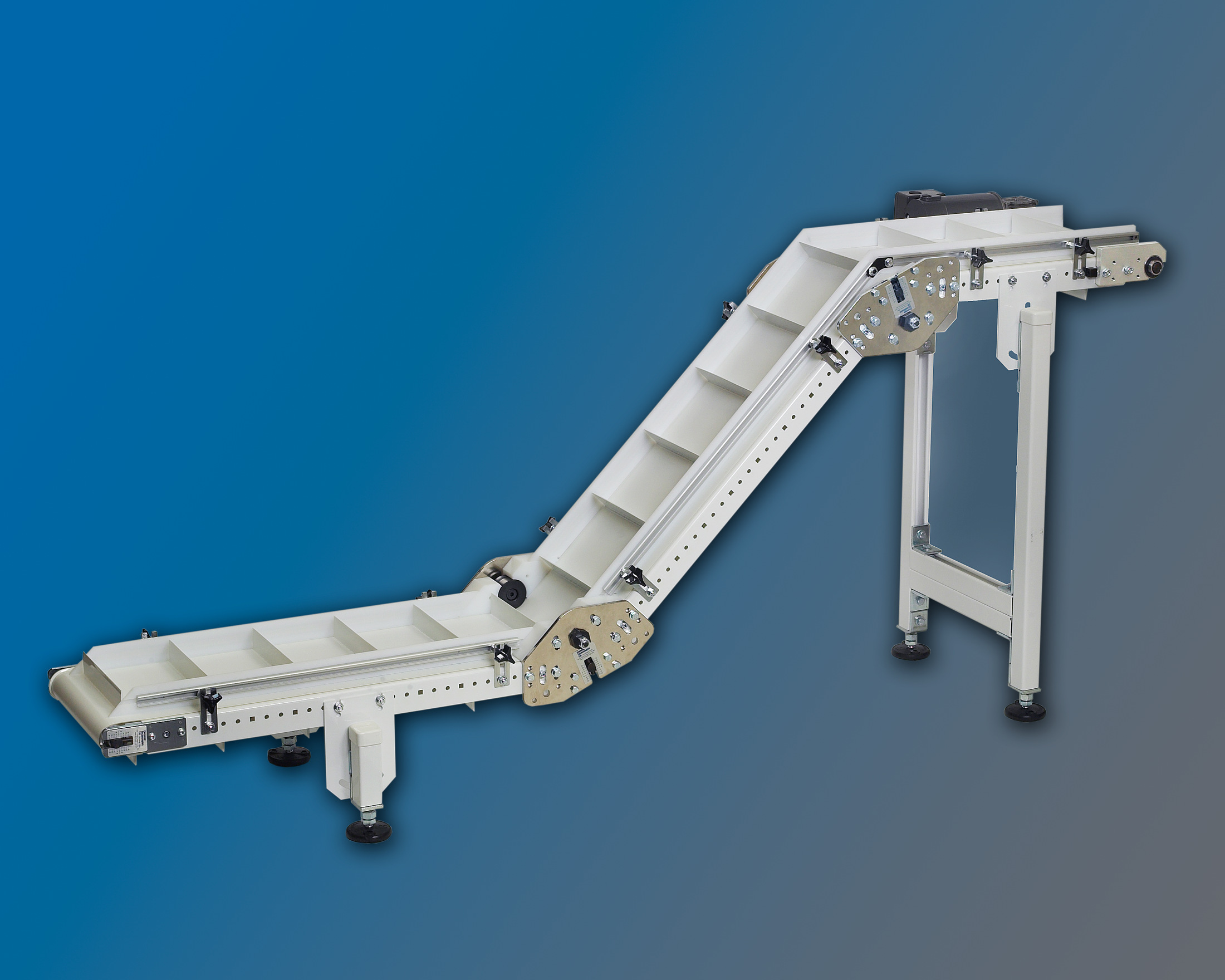
One conveyor that changes height: horizontal, inclined and declined sections join into eight layouts to carry products between levels.
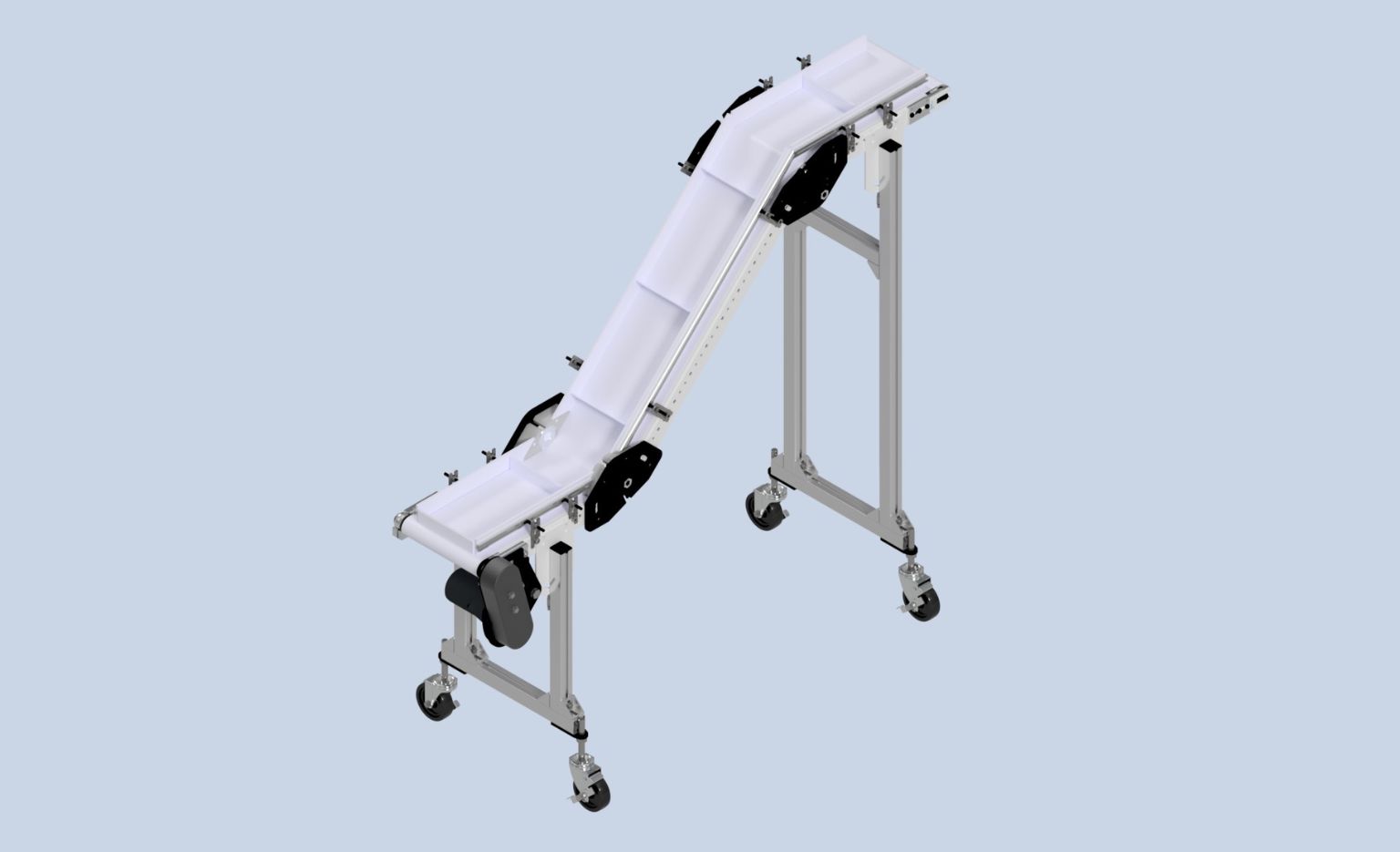
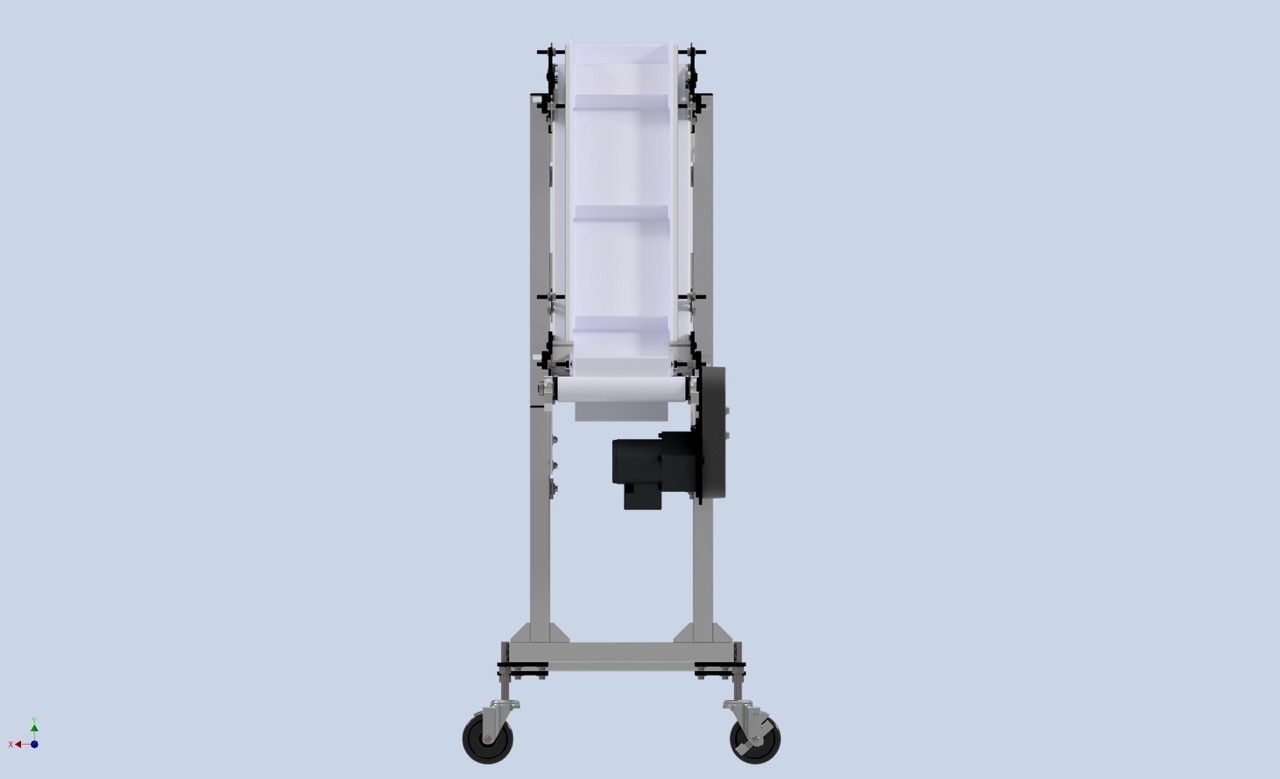
Multi-Flex VSC combines horizontal, inclined and declined sections to move products between elevations. The modular frame assembles into eight layouts, with rigid or flexible sides, cleat choices and section lengths to suit. We match the shape to the elevations and space you have.
Design it in CAD and export STEP files, or let our engineers design it.
Preview unavailable. Open original image ↗
- Layouts
- Eightrise, fall or both
- Section angles
- 30°, 45° or 60°
- Frame height
- 4 to 120 independs on layout and cleats
- Belt removal
- Tool-free
Features
Engineered for the job it does every day.
Primary feature
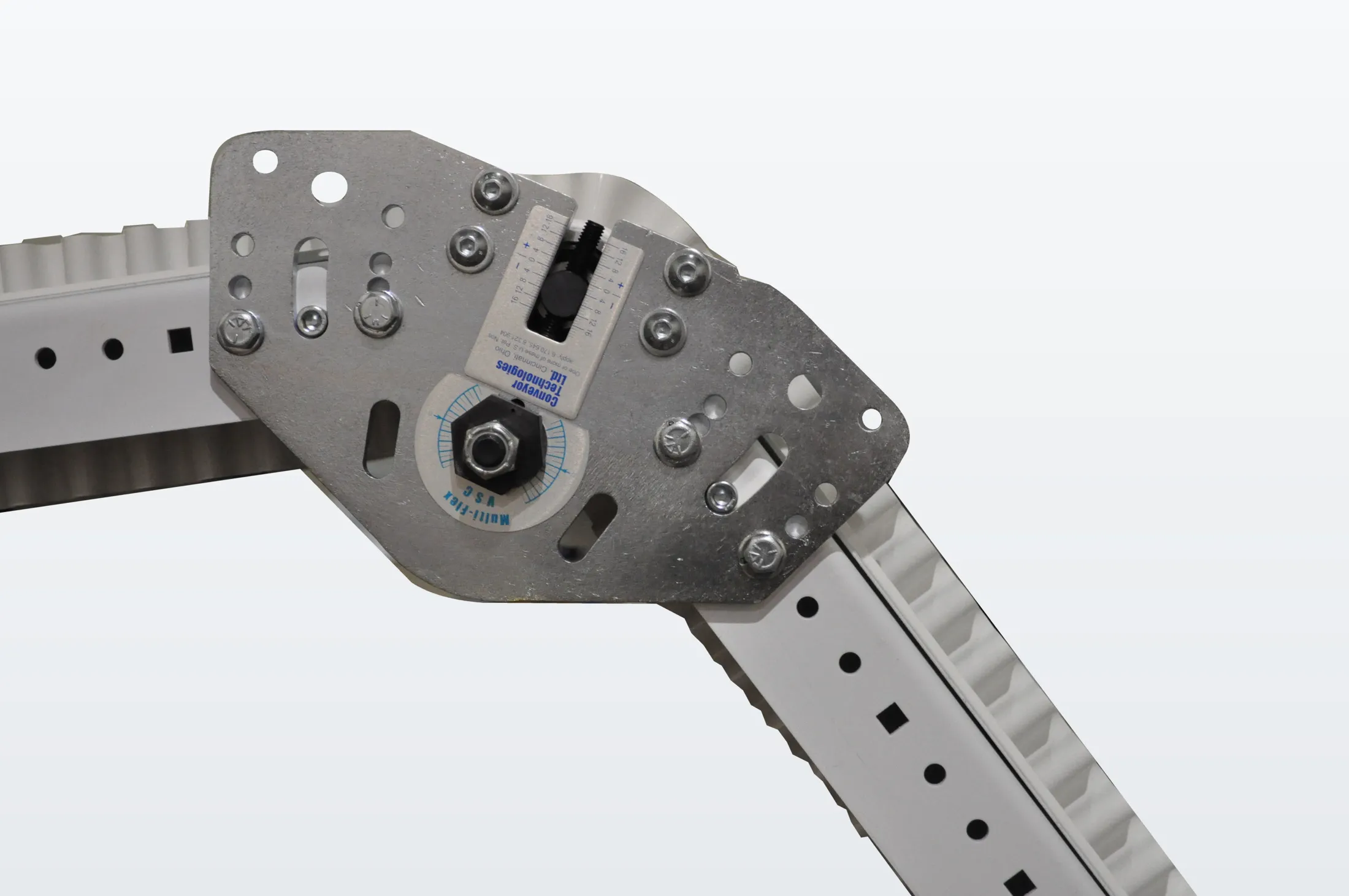
Repositionable sections and adjustable elevations
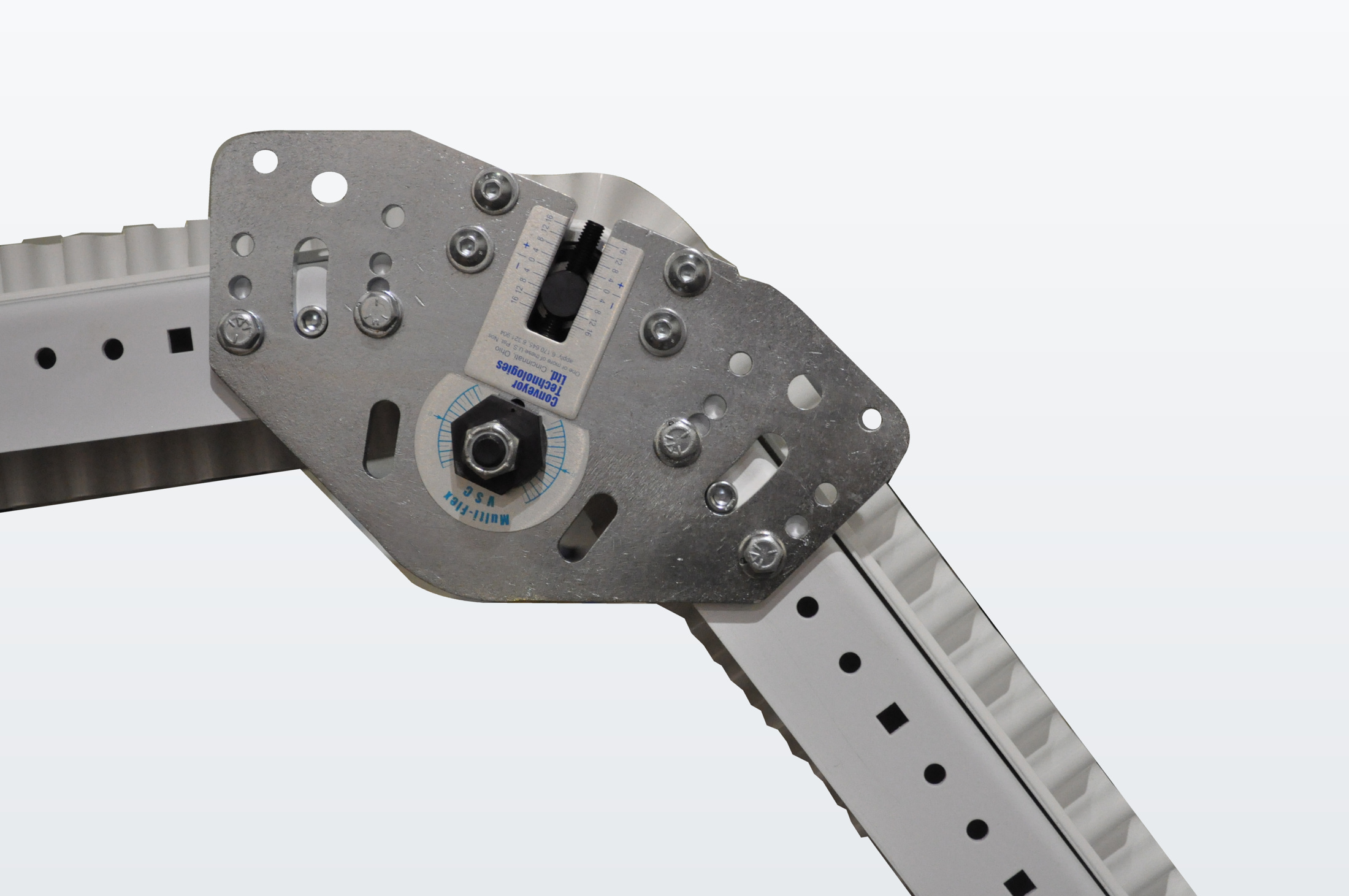
The frame sections can be repositioned to form different layouts, with 0.31 in steel transition plates keeping them aligned. A horizontal section can also be set 7.5° up or down within the layout.
In practiceThe conveyor is shaped to your start and end heights instead of the layout being shaped around the conveyor.
Tool-free belt removal
The belt-removal system gives access without tools, and tool-free guide mounting also helps when removing the endless belt.
In practiceThe belt comes off without tools, even with guides fitted.
Removal needs access to the guides, transitions and return path.
Tracking through the bends
Self-cleaning roller V-guides steer the belt through changes in slope, and calibration plates give references for belt settings. A guard and wiper keep particles out of the hold-down rollers. The belt’s high lateral stiffness resists distortion and gives up to 50% longer belt and cleat life, and the design eliminates wear on the return run.
Sealed bearings and smooth pulleys
Sealed-for-life bearings, so no lubricant reaches the belt or product, and pulleys without belt-damaging knurling. Inspection and cleaning access are still needed.
In practiceNo routine bearing lubrication in your maintenance schedule.
Layouts
Eight layouts from three sections
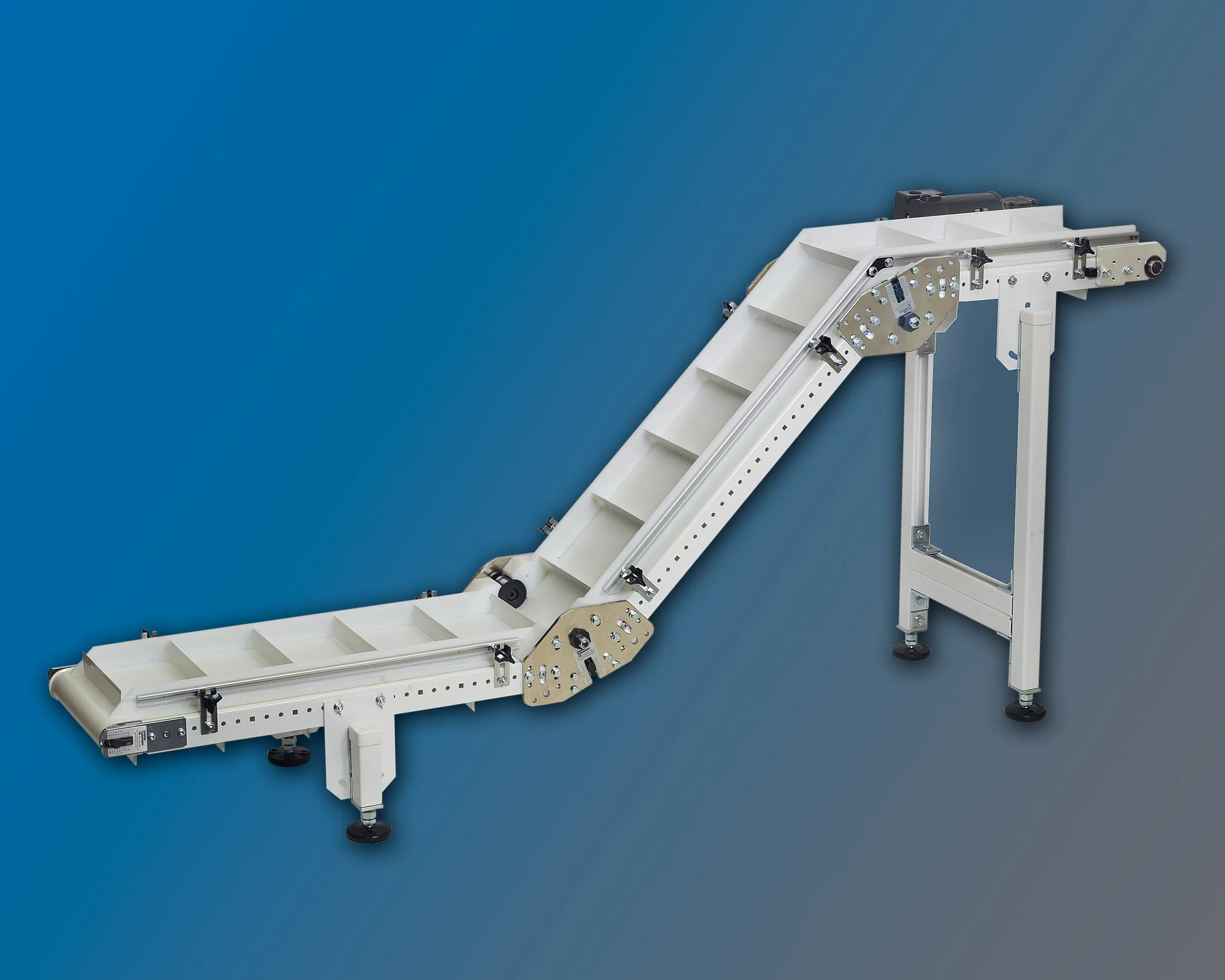
Three repositionable steel sections, joined by 0.31 in transition plates, set at 30°, 45° or 60°. We choose the layout and section lengths for the flow direction and end heights.
Layout
- HIO
Horizontal into incline
- HDO
Horizontal into decline
- IHO
Incline into horizontal
- DHO
Decline into horizontal
- HIH
Horizontal, incline, horizontal
- HDH
Horizontal, decline, horizontal
- IHD
Incline, horizontal, decline
- DHI
Decline, horizontal, incline
Sides
- Rigid sides
2.12 in more carrying width
Carrying widths 5, 7.5, 9.5, 15.5 and 21.5 in on the 7.5–24 in conveyors. Cleats 20, 25, 40 or 60 mm. - Flexible sides
For fine particles
Commonly used for particles about 9 mm across or smaller. Carrying widths 2.88–19.38 in. Cleats 25 mm.
- Section lengths
- 24–120 in, 12 in steps
- Total length
- Up to 300 in
- Horizontal section
- Can be set 7.5° up or down
Layout codes are the catalogue codes. Frame height depends on layout and cleat height.
Maintenance at a glance
Built to be maintained, not just to run.
What servicing this conveyor involves.
- Belt change
- Tool-free belt removalNeeds access to guides, transitions and return
- Tension and tracking
- Roller V-guides; calibration plates
- Bearings
- Sealed for life, with no routine lubrication
- Replacement parts and belts
- AvailableStart with the equipment identifier if you have it
Technical specifications
The numbers, with their conditions.
Section length, horizontal footprint and height change are different dimensions. Capacity varies with layout, width and angle.
| Specification | Value | Condition |
|---|---|---|
| Conveyor widths | 7.5, 10, 12, 18 and 24 in | |
| Carrying width, rigid / flexible sides | 5 / 2.88, 7.5 / 5.38, 9.5 / 7.38, 15.5 / 13.38, 21.5 / 19.38 in | For each conveyor width above, in order |
| Frame sections | Three repositionable one-piece 10-gauge steel sections | |
| Section angles | 30°, 45° or 60° | |
| Section lengths | 24 to 120 in, in 12 in steps | Can be shortened in 3 in increments |
| Maximum total length | 300 in | All three sections combined |
| Frame height | 4 to 120 in | Depends on layout and cleat height; lowest level 4–6 in on some layouts |
| Load example | 200 lb | 12 in wide, horizontal–incline–horizontal at 45°. Varies with layout, width and angle |
| Series | S or T | |
| Layout codes | HIO, IHO, HIH, IHD, DHO, HDO, HDH, DHI | Catalogue codes for the eight layouts |
Applications
Where it works, and how it fits.
The Transfer and Product Control Guide explains product handoffs. The Selection Guide compares conveyor approaches.
- Layouts
- Connecting horizontal, incline and decline runs in manufacturing
- Environments
- Cleanroom and washdownDepends on the construction, cleanroom class and cleaning conditions.
Transfers and layout
Configured with
One conveyor, one complete system.
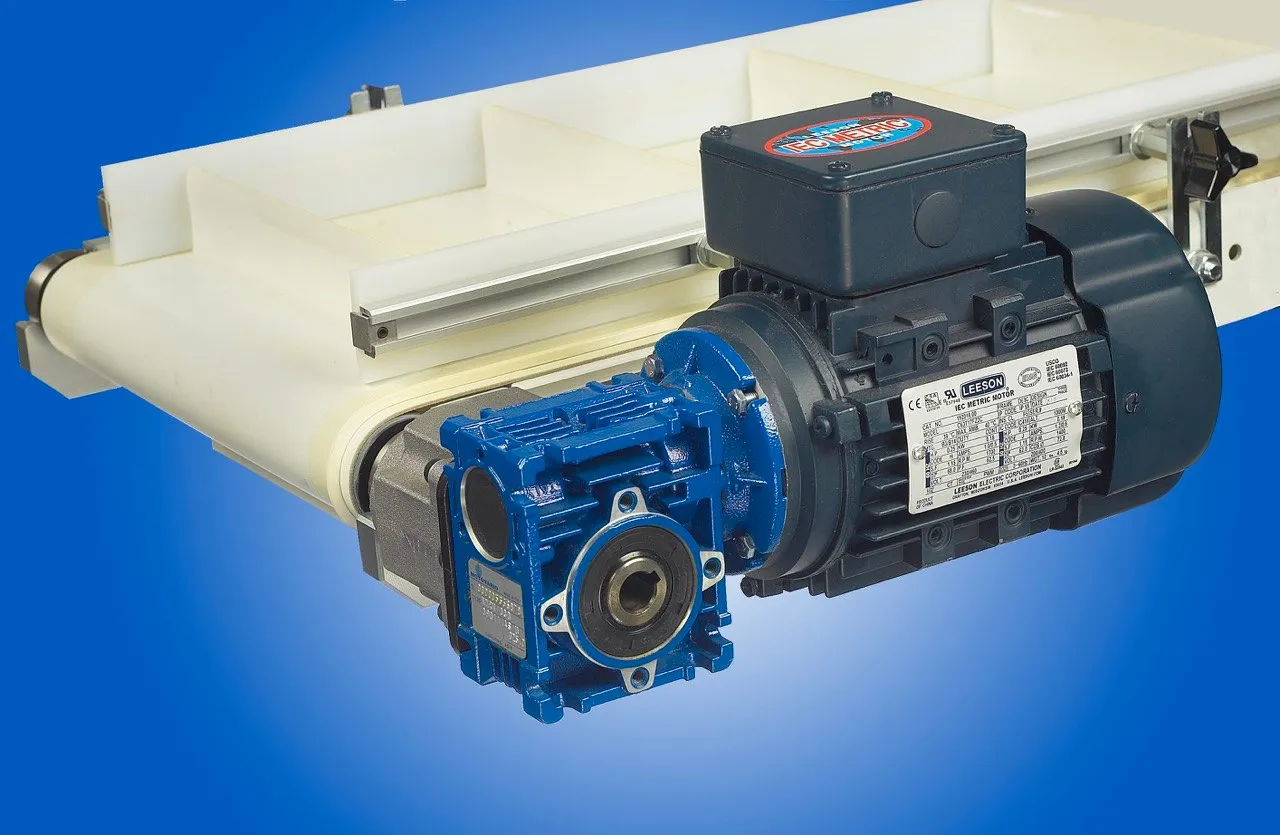
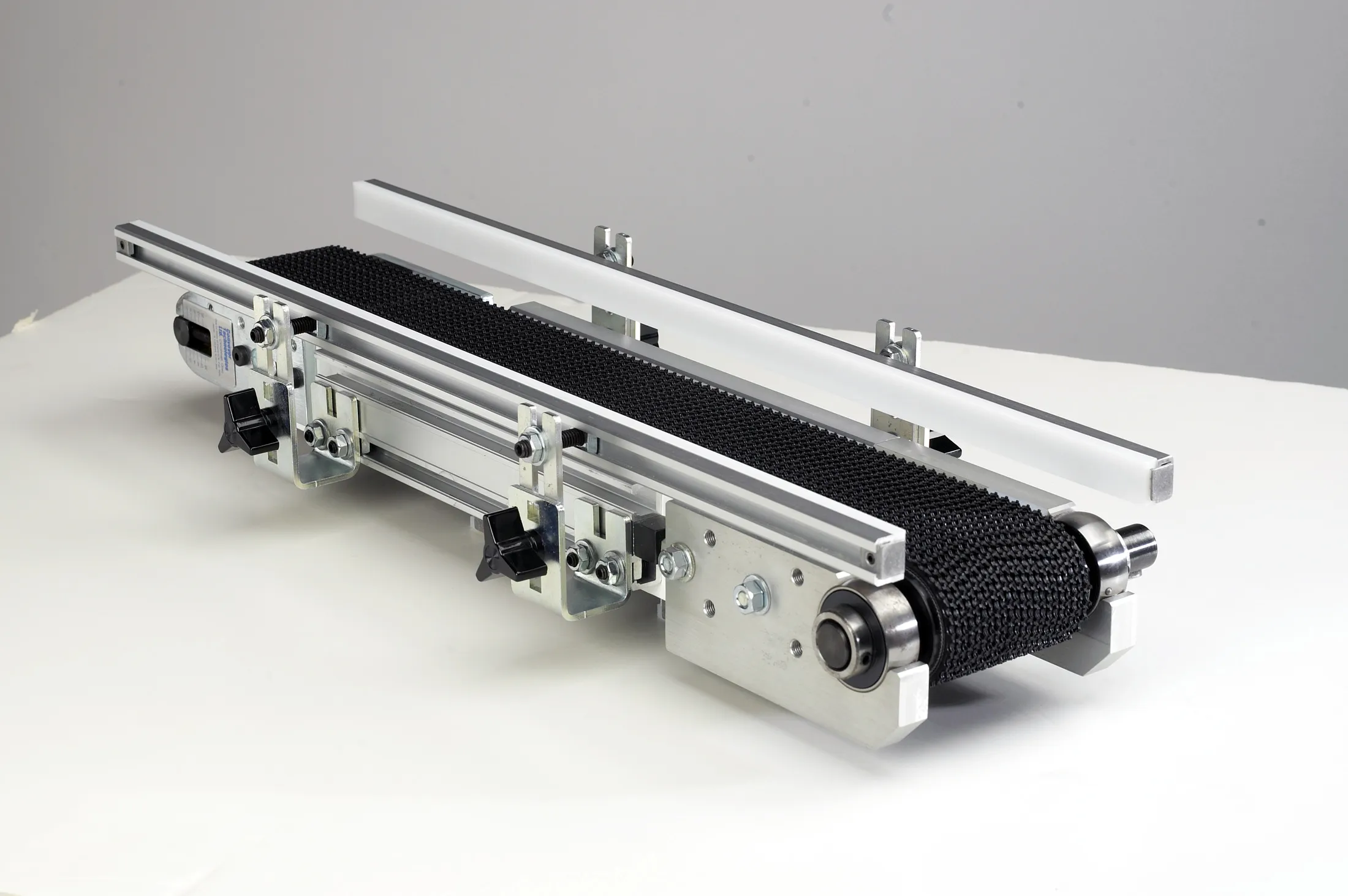
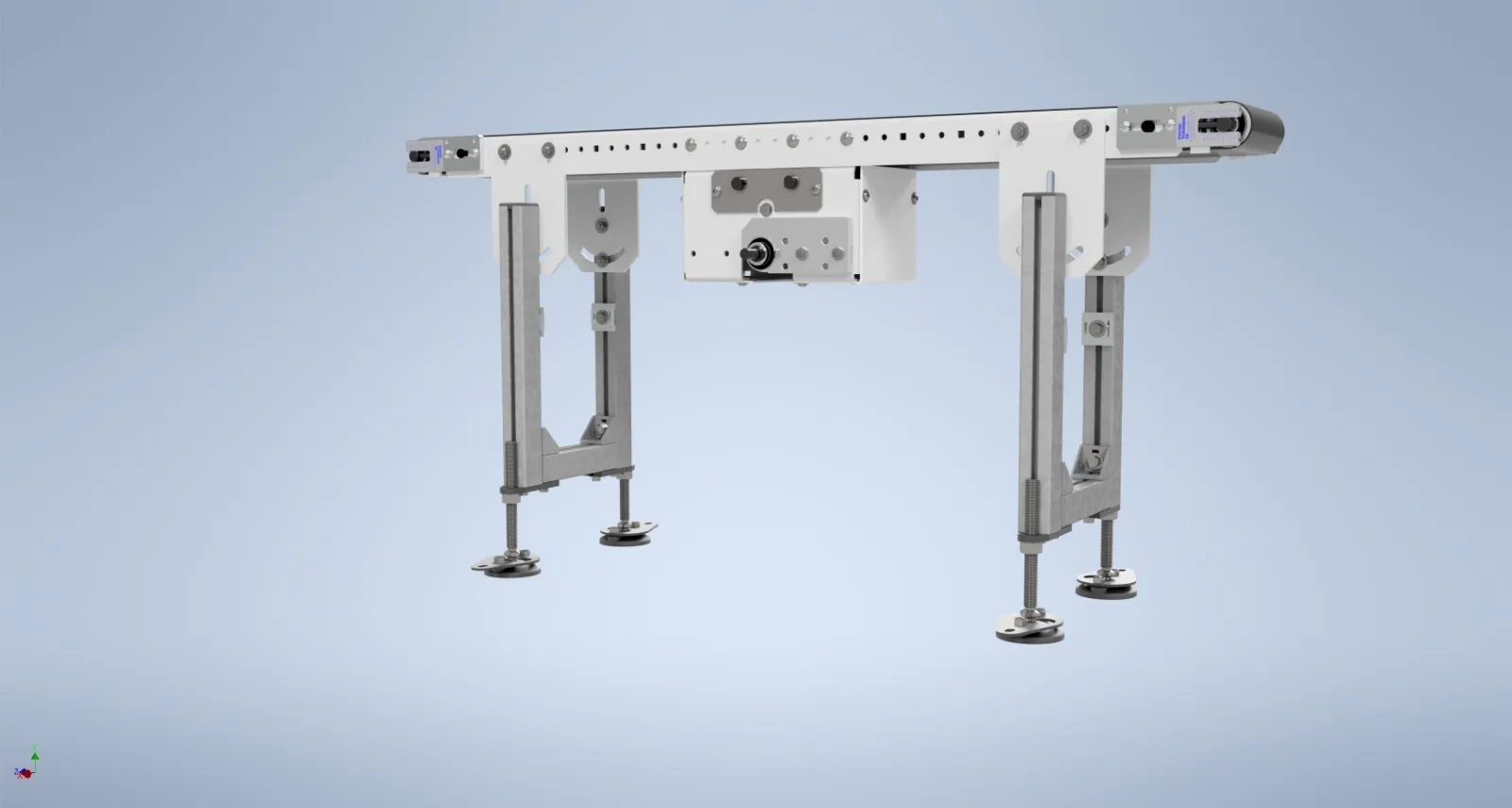
We design the drive, guides and stand with the conveyor, from the same modular system, so the parts are designed to work together.
Questions engineers ask
Tell us where the product starts and where it needs to go.
And the space between. We design and configure a Multi-Flex VSC conveyor; a brief description is all we need to start.
Talk to an engineer7.5, 10, 12, 18 and 24 in.
200 lb (12 in wide, horizontal–incline–horizontal at 45°. Varies with layout, width and angle).
Tool-free belt removal. Needs access to guides, transitions and return.
Sealed for life, with no routine lubrication.
Cleanroom and washdown. Depends on the construction, cleanroom class and cleaning conditions.
Documents and support
Everything you need, after it’s installed.
- Brochure · PDF
Multi-Flex VSC Variable Shape Conveyors
Brochure and frame-selection figures. Its warranty and contact details are out of date; use the warranty on this page and the contacts on this website.Open brochure (PDF) → Warranty
- Conveyor
- 10 years, unlimited hours
- Bearings
- 5 years
- Drive packages
- 2 years
- Existing equipment
Drawings, manuals, parts and belts
An identifier helps us find what applies to your conveyor. No identifier? Start with a description.Identify your equipment →
Compare with
Other ways to climb and save space
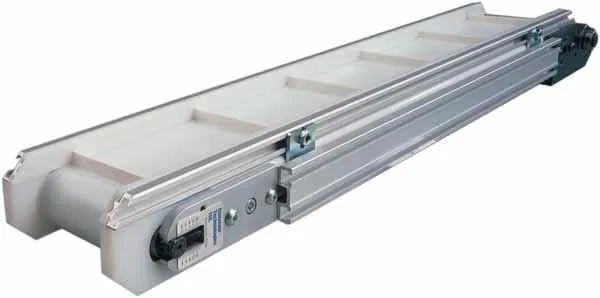 ConveyorChoose it when product must climb an incline or arrive evenly spaced.Choose it whenproduct must climb an incline or arrive evenly spaced.
Cleated Conveyors
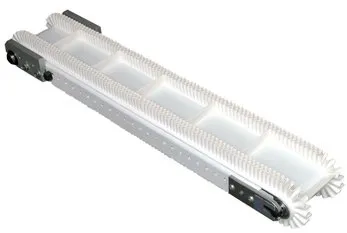 ConveyorChoose it when small or fragile products shouldn’t rub against fixed side walls.Choose it whensmall or fragile products shouldn’t rub against fixed side walls.
Flex-Side Cleated Conveyor