
Our approach
How we design conveyors, around the job and the service call.
Two questions decide every design choice: does it fit the job, and can it be kept running?
We design the conveyor, drive, guides and stand together, on one modular system, and plan the maintenance in from the first drawing.
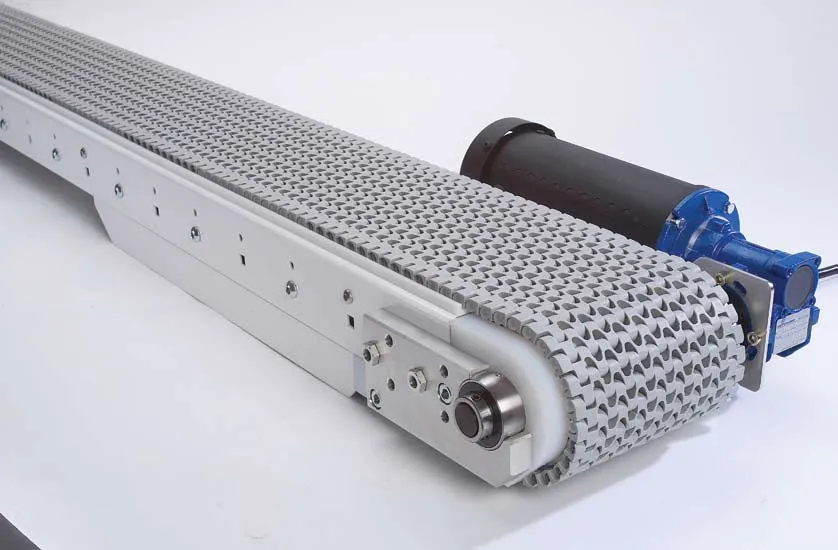
01
Built to be maintained
The company began as an answer to conveyors that needed too much attention. Service access is designed in, not worked around.
In practiceWe plan how the belt comes off your conveyor in its installed position, before it’s built.
Sealed, lubricated-for-life bearings
The lubricant stays inside the bearing, so there’s no routine relubrication.
Bearing lubricationBelt calibration gauges
A gauge on each side shows belt length and tension position, so adjustment is measured rather than guessed.
Belt tensioningFast belt and drive changes
AccuVision’s belt can be changed in two minutes. On the Shaft Mounted drive, the gearmotor changes in under two minutes.
AccuVision: when mounted on our open stand design. Shaft Mounted: with the screw-on electrical connector.
AccuVision
02
One modular system
All our low-profile conveyors are built on one patented modular concept. Components interchange between conveyor types and share our standard drives and accessories.
In practiceIf you already run one of our conveyors, much of what you know about it carries across to the next.
- 14
conveyor products
Flat belt, timing belt, cleated, vacuum, wire mesh, modular plastic and more, all on the same concept.
Compare conveyors - 7
drive arrangements
Inline, right angle, bottom mounted, shaft mounted and high speed options, chosen for the space around the conveyor.
Drive systems - 3 + 2
Side guides and stands
Fixed and two-axis side guides, and aluminum or steel stands, to complete the arrangement.
Side guides
03
Fit the machine and the job
Low-profile conveyors are chosen for tight spaces between operations. Where the drive sits and how the part is held matter as much as the belt.
In practiceA photo of the space and the machines on either side helps us design the fit, beyond the length alone.
Drive position
End, center or below the conveyor, placed so the drive clears the equipment around it.
OEM & Machine IntegrationHow the part is carried
Flat belt, holders, cleats, vacuum or backlighting, chosen for what happens at the next station.
ApplicationsThe transfer
We look at how the part crosses each handoff, not just the conveyor between them.
Transfer guide
04
Start with the job, give straight answers
No model number or specification needed to start, and every figure we give comes with the conditions it depends on.
In practiceWe confirm every figure on your quote and drawing for your arrangement before you order.
We start from your description
A short description of the part and the operation is all our engineers need to begin designing.
Engineering HelpGuides that explain the choices
The Selection Guide and Conveyor Belts 101 explain the options our engineers weigh when designing your conveyor.
ResourcesDocuments for what you run
Brochures, drawings and reference sheets, and help finding the right document for older equipment.
Documentation
Specifications you can rely on
Every figure, with the conditions behind it.
A figure is only useful with the conditions it depends on, so we give both, and confirm them for your arrangement before you order.
| What we state | The condition beside it |
|---|---|
| Two-minute belt change on AccuVision | When mounted on our open stand design. |
| Gearmotor change in under two minutes | Shaft Mounted drive, with the screw-on electrical connector. |
| No routine relubrication | Applies to the sealed bearings. Belts, drives and other parts keep their own maintenance. |
| Torque Load Chart values | Depend on the bed, incline and drive; a chart value alone isn’t a complete conveyor rating. |
Your line
See how it applies to your line.
Describe the part and the space, and we’ll design the arrangement around it.